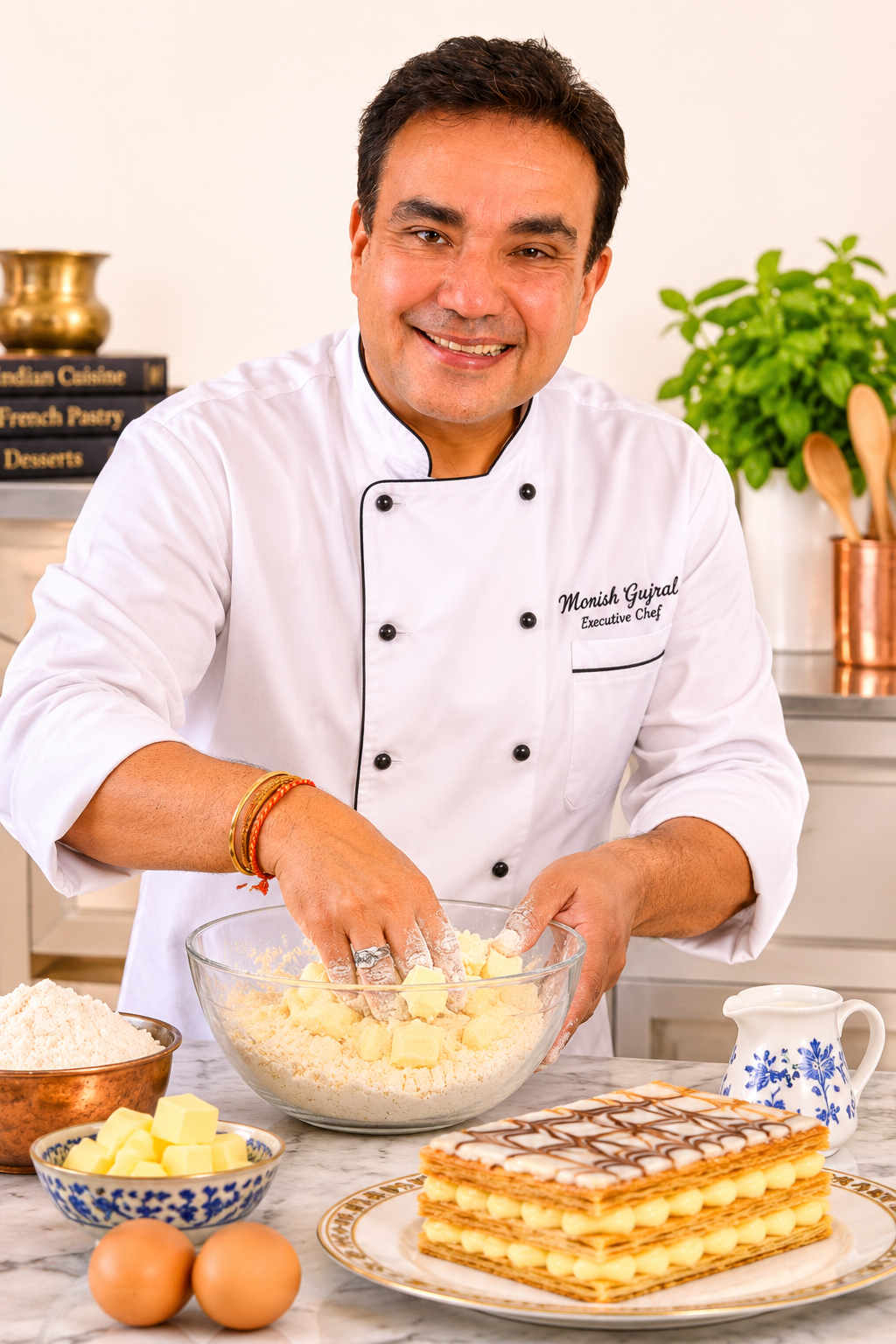
There are some desserts that are remembered simply because they are sweet. And then there are desserts that tell a story.
For me, the Napoleon pastry is one of those desserts. With its crisp, buttery layers of puff pastry, silky pastry cream and delicate glaze, it is as much about texture and craftsmanship as it is about taste.
Often called Mille-Feuille, meaning “a thousand leaves” in French, the pastry is built around one of the great ideas of European pastry-making: take simple ingredients—flour, butter, sugar, eggs and milk—and transform them through patience, technique and layers.
A pastry of many stories
The exact invention of the Napoleon is not as clear-cut as its name might suggest.
The French pastry known as mille-feuille evolved from the tradition of laminated pastry, in which butter is folded repeatedly into dough to create hundreds of delicate layers. Early versions of layered pastries appeared in European culinary history over several centuries, while the modern mille-feuille became established in France.
The name Napoleon is particularly associated with versions of the pastry served outside France, especially in Russia and parts of Eastern Europe. One popular story connects it with celebrations surrounding Napoleon Bonaparte, although food historians generally regard the precise origin of the name as uncertain.
And perhaps that uncertainty makes the pastry even more fascinating.
Food rarely travels in a straight line. Recipes cross borders, chefs reinterpret them, and names change as dishes enter new cultures.
That is something I have always found fascinating about food.
Why “Mille-Feuille”?
The name itself describes the magic.
Mille-feuille means “a thousand leaves.”
Of course, the pastry does not literally contain a thousand layers. The expression celebrates the extraordinary number of fine, flaky layers created when puff pastry is rolled and folded with butter.
When baked correctly, the pastry rises into a beautiful architecture of crisp layers.
Then comes the contrast.
Between those crisp sheets sits a smooth pastry cream—rich, creamy and delicately sweet. The first bite gives you the crackle of pastry, followed by the softness of the cream.
That contrast is the soul of the dessert.
My way of looking at the Napoleon
What I love about classic European pastries is that they teach the same lesson that Indian cuisine teaches us: technique can transform humble ingredients into something extraordinary.
Flour becomes pastry.
Milk becomes custard.
Eggs become a luxurious cream.
Sugar becomes caramel and glaze.
Butter creates the layers.
The magic isn’t necessarily in expensive ingredients. It is in understanding them.
In my own culinary journey, I have always enjoyed exploring how recipes travel across cultures. Indian cuisine has evolved through centuries of interaction with Central Asia, Persia, Europe and the many communities that made India their home.
The Napoleon is another beautiful example of how food becomes part of a shared global culinary language.
My Classic Napoleon Pastry Recipe
Ingredients
For the pastry
- 500 g puff pastry dough
- Flour, for dusting
- 1 egg, beaten, optional for brushing
For the pastry cream
- 500 ml full-fat milk
- 4 egg yolks
- 100 g sugar
- 40 g cornflour
- 1 teaspoon vanilla extract
- 30 g butter
For the glaze
- 150 g icing sugar
- 2–3 tablespoons milk or water
- 1 teaspoon lemon juice
Method
1. Prepare the pastry
Roll the puff pastry into a thin rectangle on a lightly floured surface.
Prick it all over with a fork. This prevents the pastry from puffing excessively and helps create relatively even layers.
Place it on a baking tray lined with parchment paper.
Bake in a preheated oven at 200°C for approximately 15–20 minutes, or until beautifully golden and crisp.
Allow it to cool completely.
For an especially flat and refined Napoleon, place another sheet of parchment and a light baking tray on top during part of the baking process.
2. Make the pastry cream
Heat the milk gently in a saucepan until hot but not boiling.
In another bowl, whisk together the egg yolks, sugar and cornflour until smooth.
Slowly pour the hot milk into the egg mixture while whisking continuously.
Return everything to the saucepan.
Cook over medium-low heat, stirring constantly, until the mixture becomes thick and creamy.
Remove from the heat and stir in the vanilla and butter.
Cover the surface directly with cling film and cool completely.
3. Assemble
Trim the baked puff pastry into three equal rectangles.
Place the first layer on a serving plate.
Spread a generous but even layer of pastry cream over it.
Place the second pastry layer on top and repeat.
Finish with the third pastry layer.
Press very gently so that the layers remain intact.
4. Glaze
Mix the icing sugar with the milk or water and lemon juice until you have a smooth, spreadable glaze.
Spread it over the top layer.
For the traditional decorative finish, melt a small amount of dark chocolate and pipe thin lines across the white glaze. Drag a toothpick through the chocolate lines in alternating directions to create the classic feathered pattern.
Refrigerate for at least 2–3 hours before cutting.
Use a sharp serrated knife and cut gently so that the pastry doesn’t collapse.
The beauty of a layered dessert
The Napoleon reminds me that some of the best things in food require patience.
You cannot rush the lamination.
You cannot rush the pastry cream.
And you certainly cannot rush the final assembly.
Every layer has a purpose.
Perhaps that is why I enjoy desserts like this. They are edible history. They carry the memory of the kitchens that created them and the generations that adapted them.
From the French mille-feuille to the Napoleon pastry found in different parts of the world, the recipe has travelled, changed names and acquired new stories.
And that, to me, is the real beauty of food.
Recipes have no borders. They travel with people, absorb new cultures and become part of our shared culinary heritage.
A Napoleon may have a thousand leaves, but behind every layer is a story.
— Monish Gujral