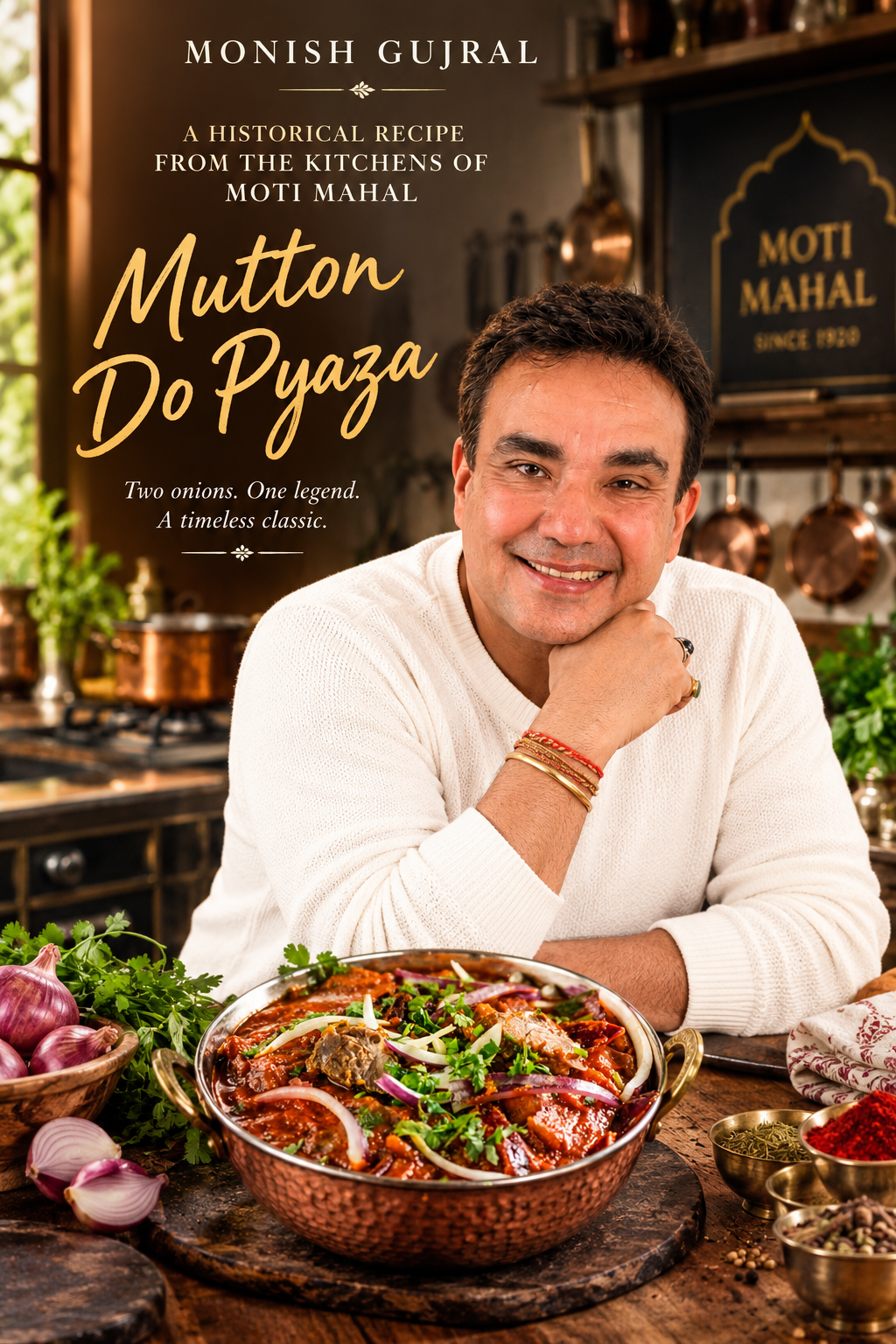
Mutton Do Pyaza is one of the most celebrated dishes of the Indian subcontinent’s Mughlai culinary tradition. Known for its tender pieces of mutton, aromatic spices, rich gravy and generous use of onions, it is a dish in which a humble ingredient is transformed into something extraordinary through technique and patience.
As someone who has grown up preserving the culinary legacy of Moti Mahal, I have always found dishes like Do Pyaza fascinating. They tell us how Indian cuisine evolved through royal kitchens, regional traditions and the ingenuity of cooks who understood that the secret of great food lies not merely in the ingredients, but in how they are used.
The history and possible origins of Mutton Do Pyaza
The name Do Pyaza literally means “two onions” in Persian-influenced culinary terminology: do means two, and pyaz means onion. The name is commonly understood to refer to the use of onions in two stages of cooking, although recipes differ in their interpretation.
The dish is associated with the broader Mughlai and North Indian culinary traditions, which developed through centuries of interaction between Persian, Central Asian and Indian cooking practices. Onions, yoghurt, ghee and aromatic spices became essential components of many rich meat preparations.
There is a popular culinary legend linking Do Pyaza to the Mughal court and to a cook who supposedly added onions in unusually generous quantities. However, the precise inventor and date of invention are not firmly established by reliable historical records. It is therefore more accurate to regard Mutton Do Pyaza as a dish that evolved through the subcontinent’s rich cooking traditions rather than attribute it definitively to one individual.
Over time, regional versions emerged. Some use a smooth, deeply browned onion gravy, while others feature substantial onion petals added towards the end. The latter lend the dish its characteristic texture and a gentle sweetness that balances the savoury richness of the mutton.
This version combines the depth of browned onions with the texture and sweetness of onion petals added later. It is a home-style Mughlai-inspired recipe, rather than a claim to reproduce one definitive historical formula.
Ingredients
For the mutton
- 750 g mutton, preferably bone-in
- 4 large onions (about 500–600 g), thinly sliced
- 2 medium onions, cut into petals
- 150 g thick yoghurt, whisked
- 2 tbsp ginger-garlic paste
- 3 tbsp ghee or mustard oil
- 1 tsp Kashmiri red chilli powder
- 1 tsp coriander powder
- ½ tsp turmeric powder
- 1 tsp cumin powder
- ½ tsp garam masala
- Salt to taste
Whole spices
- 1 bay leaf
- 1-inch cinnamon stick
- 4 green cardamoms
- 4 cloves
- 1 black cardamom
- 1 tsp cumin seeds
- 6–8 black peppercorns
For the finish
- 1 tsp crushed kasuri methi (optional)
- 2 tbsp chopped fresh coriander
- ½ tsp freshly ground black pepper, if desired
- Warm water as required
For the mutton750 g mutton, preferably bone-in4 large onions (about 500–600 g), thinly sliced2 medium onions, cut into petals150 g thick yoghurt, whisked2 tbsp ginger-garlic paste3 tbsp ghee or mustard oil1 tsp Kashmiri red chilli powder1 tsp coriander powder½ tsp turmeric powder1 tsp cumin powder½ tsp garam masalaSalt to taste
Whole spices1 bay leaf1-inch cinnamon stick4 green cardamoms4 cloves1 black cardamom1 tsp cumin seeds6–8 black peppercorns
For the finish1 tsp crushed kasuri methi (optional)2 tbsp chopped fresh coriander½ tsp freshly ground black pepper, if desiredWarm water as required Copy ingredients
Method
1. Brown the onions
Heat the ghee in a heavy-bottomed handi or pan. Add the sliced onions and cook over medium heat until deep golden brown. Remove roughly one-third and reserve for the garnish. Let the rest cook until soft and caramelised, without burning.
2. Build the masala
Add the cumin seeds, bay leaf, cinnamon, cardamoms, cloves and peppercorns. Stir briefly, then add the ginger-garlic paste and cook until its raw aroma disappears. Add the mutton and sear for 8–10 minutes, stirring to coat the pieces in the spices.
3. Add yoghurt and ground spices
Lower the heat. Add turmeric, coriander, cumin and Kashmiri chilli powder. Gradually mix in the whisked yoghurt, stirring continuously so it does not split. Cook until the masala thickens and the ghee begins to separate at the edges.
4. Slow-cook the mutton
Add warm water to make a thick gravy. Cover and simmer gently for 60–90 minutes, stirring occasionally, until the meat is tender. Add more water if needed. A pressure cooker can shorten the cooking time; follow your cooker’s instructions.
5. Add the second onions
In a separate pan, sauté the onion petals until lightly golden but still holding their shape. Add them to the cooked mutton along with the reserved browned onions. Simmer uncovered for another 8–10 minutes. Finish with garam masala, crushed kasuri methi if using, black pepper and fresh coriander.
Chef’s tips
- The two-onion technique: The first addition develops sweetness and body in the gravy; the second contributes texture and a fresher onion flavour.
- Avoid burning the onions: Dark brown onions add depth, but burnt onions make the gravy bitter.
- Let the mutton cook slowly: Gentle cooking allows the meat to become tender while the spices blend into the sauce.
- Serve traditionally: Pair with roomali roti, tandoori naan, sheermal or fragrant basmati rice.
The culinary legacy of Do Pyaza
Historical cookery texts associated with the Mughal period, including the Nuskha-i-Shahjahani, describe do pyaza among their meat preparations.
For me, the enduring appeal of Mutton Do Pyaza lies in the culinary intelligence behind it: an everyday ingredient, used in two different ways, produces two layers of flavour. It is a wonderful example of the sophistication of India’s historic meat-cooking traditions.
Recipe note: This is a modern, Mughlai-inspired adaptation for a home kitchen, not a transcription of a historical royal recipe.