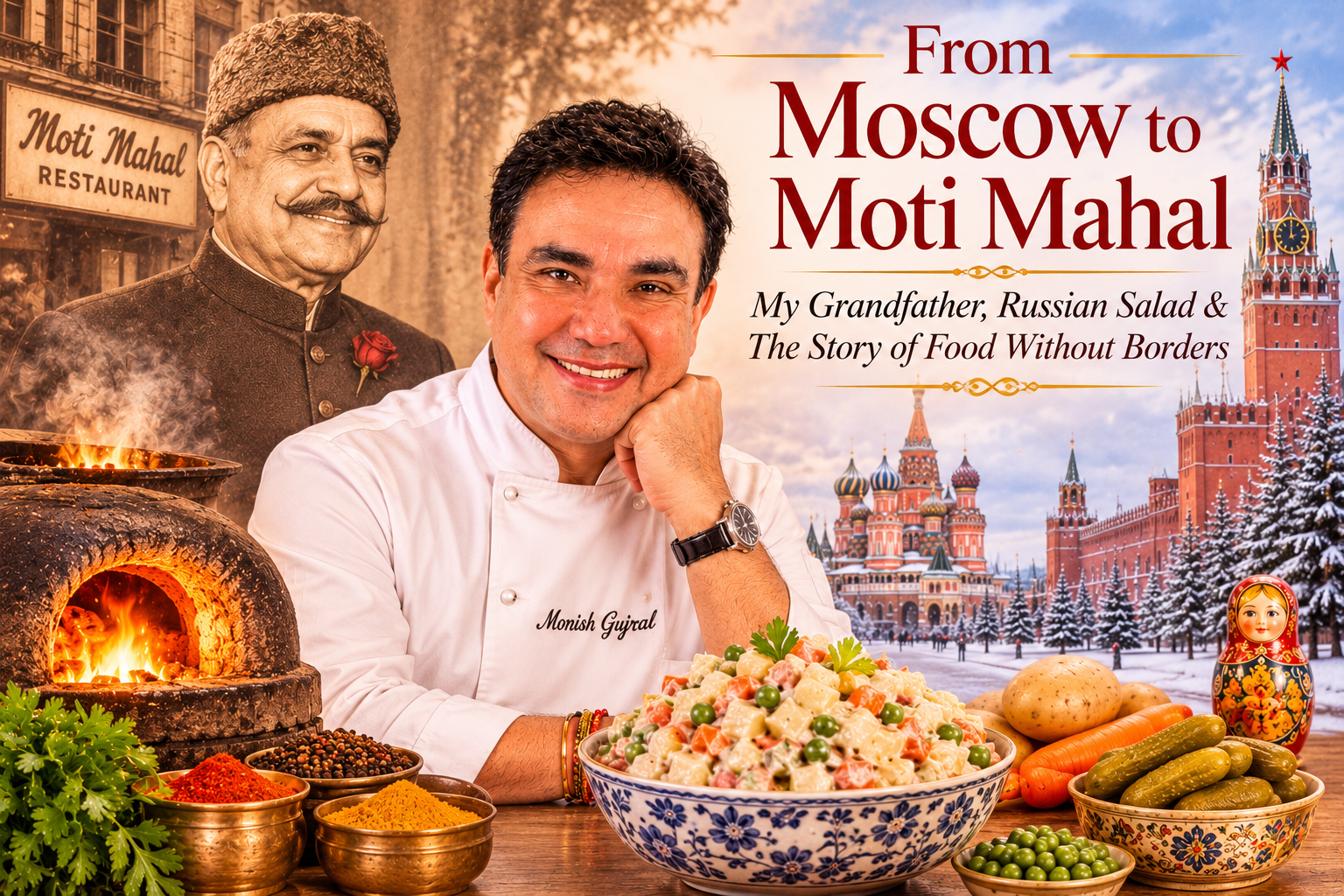
There are some stories that you don’t learn from books.
You inherit them.
They come to you across a dining table, sitting beside your grandfather, listening to his voice, watching his hands move as he describes a place he had seen decades before you were born.
For me, Russia is one of those stories.
Whenever I think of Russia, I don’t first think of the Kremlin, Red Square or the snow-covered streets of Moscow.
I think of my grandfather, Kundan Lal Gujral, sitting with me and telling me about his journey to Russia in the 1960s.
I was fascinated.
How could a man who had grown up in Peshawar, who had built his reputation around a humble Indian tandoor, find himself taking Moti Mahal all the way to Moscow?
And what I loved most were the little details in his stories—the people, the food, the cold, the curiosity and the amazement of Russians seeing Indian cooking in a completely different form.
My grandfather’s Moscow
My grandfather was invited to Moscow during the Soviet era, when Nikita Khrushchev was the country’s most powerful political figure.
The Moti Mahal family history records that Khrushchev had been impressed by my grandfather’s cuisine and invited him to take Moti Mahal to Moscow. In 1963, my grandfather set up Moti Mahal at an international trade fair there.
For me, this is more than a historical fact.
It is a picture I have carried in my imagination since childhood.
I would imagine my grandfather standing in Moscow, surrounded by people speaking a language he did not understand, while his cooks were preparing food whose language needed no translation.
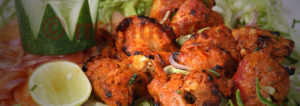
Tandoori chicken.
The smoke from the charcoal.
The warmth of the tandoor.
The aroma of spices.
And the curious faces of people discovering something completely unfamiliar.
My grandfather would tell me about the Russians and how interested they were in Indian food.
He understood something very early in his life that I have also come to believe deeply:
Food can travel where language cannot.
You may not understand someone’s words, but you understand the pleasure of a perfectly cooked piece of chicken, the warmth of bread, the fragrance of spices or the comfort of a shared meal.
That was my grandfather’s diplomacy.
His kitchen was his embassy.
And then there is Russian Salad
Whenever we talk about Russia and food, one dish inevitably comes to mind around the world:
Russian Salad.
In Russia it is known as Olivier Salad, named after Lucien Olivier, the French-speaking chef associated with Moscow’s famous Hermitage Restaurant.
But the fascinating thing about Olivier Salad is that the dish we know today is almost nothing like the extravagant creation that made Olivier famous.
The story begins in Moscow in the 1860s.
Lucien Olivier created an elaborate dish at the Hermitage, a restaurant that catered to Moscow’s wealthy and sophisticated diners.
The original was a magnificent culinary composition involving hazel grouse, crayfish, potatoes, cucumbers, lettuce, capers, olives, aspic and a Provençal-style mayonnaise dressing. Historical sources also mention truffles and other luxurious ingredients in versions associated with the original.
It was a dish of luxury.
A dish of theatre.
A dish that belonged to nineteenth-century Moscow’s grand restaurant culture.
But, as happens so often in the history of food, the diners changed the invention.
There is a wonderful story that Olivier’s customers would mix the carefully arranged ingredients together on their plates rather than eating the dish as he had presented it.
As a chef, I can almost imagine his horror!
He had created a beautiful composition.
His guests simply took a spoon and mixed everything together.
And perhaps, unknowingly, they had discovered the future of the dish.
The original Olivier Salad — as close as history allows us to recreate it
There is an important culinary mystery here.
Olivier’s exact original recipe was never reliably preserved.
The earliest known published versions appeared after his death, including a recipe published in the Russian magazine Nasha Pishcha in 1894. A later culinary text from the 1890s gives one of the best-known historical reconstructions.
So rather than calling the following the exact secret recipe, I prefer to call it a historical reconstruction of the late-19th-century Olivier Salad.
Historical Olivier Salad
Ingredients
- 3 hazel grouse
- 5 waxy potatoes
- 5 small cucumbers
- 2 heads of lettuce
- 15 cooked crayfish tails
- About 1 glass of aspic, cut into pieces
- Capers
- Olives
- Cornichons
- 3 truffles
- Provençal mayonnaise-style sauce
The historical recipe describes roasting the grouse, removing the meat and cutting it into pieces. The potatoes were boiled and sliced, while the other ingredients were prepared separately and combined with the dressing.
The dressing itself was essentially a Provençal sauce, a mayonnaise-like emulsion made with oil and egg yolks, sharpened with vinegar and mustard. Some historical accounts also mention Soy-Kabul sauce, an intensely savoury condiment that contributed to the distinctive flavour of the dish.
Imagine serving that at a grand Moscow restaurant in the nineteenth century.
It wasn’t the humble potato-and-pea salad that most of us know today.
It was a luxurious arrangement of game, seafood, pickles, herbs, aspic and a rich dressing.
Over the decades, history changed it.
The expensive ingredients disappeared.
Grouse gave way to chicken, sausage or other accessible meats.
Crayfish disappeared.
Truffles became a memory.
Potatoes, carrots, peas, pickles and mayonnaise became the familiar combination.
And somehow, the dish became more Russian than the original.
That is what I love about food
As a chef and as someone who has spent my life studying Indian culinary heritage, this transformation fascinates me.
A recipe is never really finished.
People take it into their homes.
They adapt it.
They change it according to what is available.
They make it their own.
And eventually, the new version becomes tradition.
That is how food travels.
That is how cuisine evolves.
And perhaps that is why my grandfather’s Moscow story feels so connected to Olivier Salad in my mind.
Olivier was a French-speaking chef who created a dish in Moscow that became part of Russian culinary identity.
My grandfather was an Indian chef who took the flavours of India to Moscow.
Two culinary journeys meeting in the same city, separated by decades but connected by the same belief—that food brings people together.
What my grandfather left me
When I think of my grandfather today, I don’t only remember the famous dishes associated with him—Tandoori Chicken, Butter Chicken or Dal Makhani.
I remember the stories.
I remember how proudly he spoke about taking Indian food beyond India’s borders.
I remember the sense of adventure in those stories.
For him, opening a restaurant was never simply about selling food.
It was about introducing people to a culture.
And perhaps that is why I have spent my own life following food trails—from the Tandoori Trail to exploring cuisines and culinary traditions around the world.
My grandfather taught me that every dish has a story behind it, and every story has a journey.
From Peshawar to Moscow
Sometimes I wonder what my grandfather must have felt when he first saw Moscow.
He had already lived through enormous change.
He had left Peshawar after Partition.
He had rebuilt Moti Mahal in Delhi.
He had created a culinary tradition that would eventually become known around the world.
And then, thousands of kilometres away, in a completely different political and cultural world, he was standing in Moscow with his tandoor.
Perhaps he looked at the snow and thought of the heat of his kitchen.
Perhaps he wondered how Russians would react to Indian spices.
Perhaps he simply smiled.
Because my grandfather had always believed in food.
And food had never failed him.
A Russian salad and an Indian tandoor
Today, when I prepare or eat Russian Salad, I don’t see just potatoes, peas, carrots and mayonnaise.
I see Moscow.
I see Lucien Olivier in his grand restaurant.
I see the evolution of a dish from luxury to everyday comfort.
And somewhere in that picture, I see my grandfather.
A man from Peshawar carrying the Indian tandoor to Moscow.
That is why food history is personal for me.
It is not merely about dates, ingredients and recipes.
It is about people.
It is about memories passed from one generation to another.
It is about the places our ancestors travelled and the tables at which they sat.
And sometimes, it is about a grandfather telling his grandson a story that stays with him for the rest of his life.
From Olivier’s Moscow to my grandfather’s Moti Mahal, the lesson remains the same: food has no borders.
It crosses languages.
It crosses politics.
It crosses generations.
And when we sit down together at the same table, for a few precious moments, the world becomes a little smaller.
That is the Russia I remember—not only through history, but through my grandfather’s eyes.