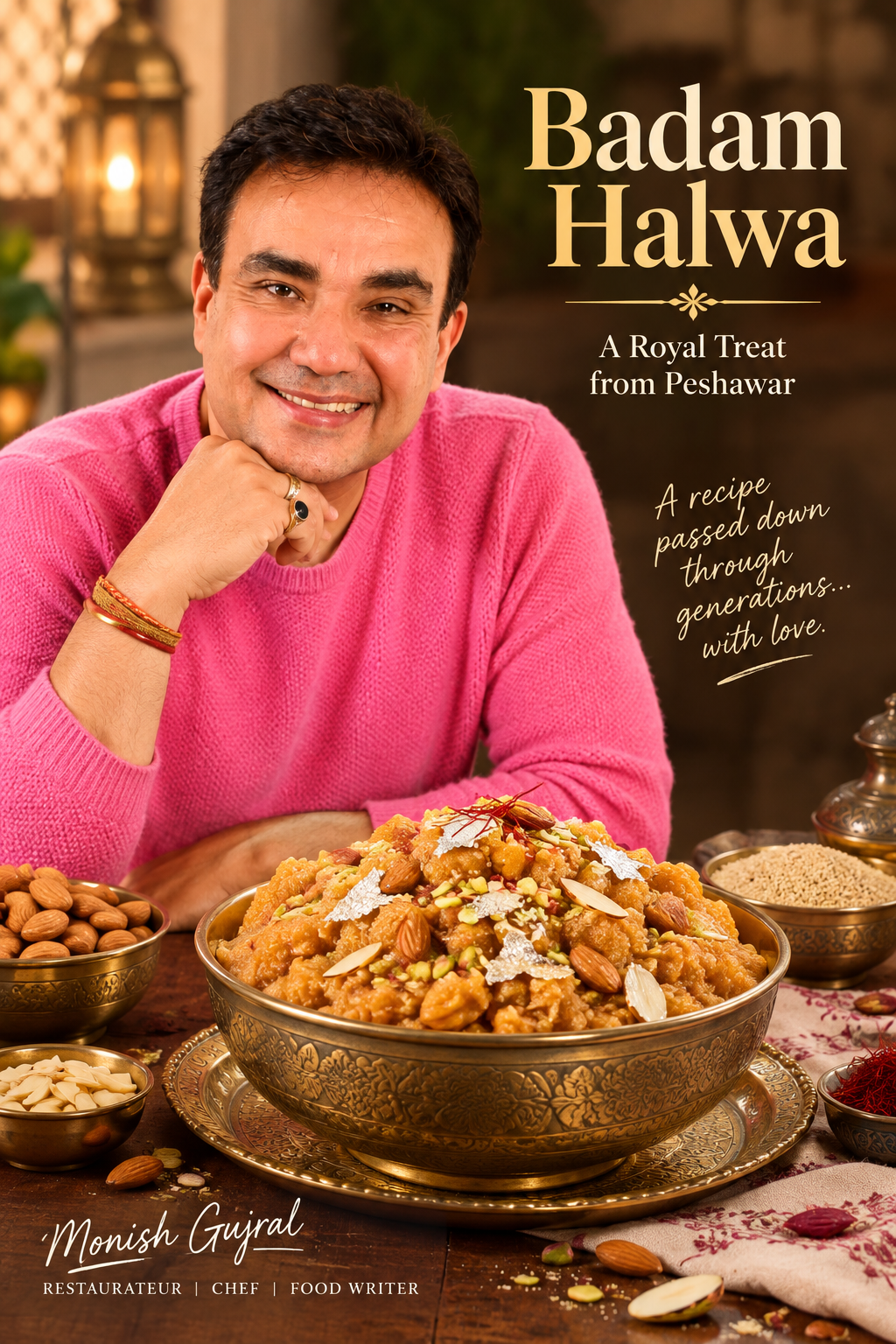
By Monish Gujral
Some recipes are more than a combination of ingredients. They are memories passed down through generations, carrying the fragrance of a grandmother’s kitchen, the warmth of a family gathering, and the culinary wisdom of those who came before us.
For me, Badam Halwa is one such recipe. Every time I think of its rich aroma, the delicate sweetness of almonds, and the slow stirring that transforms simple ingredients into something extraordinary, I am transported back to the stories of Peshawar and the culinary legacy of my grandfather, Kundan Lal Gujral, the legendary founder of Moti Mahal.
Growing up in a family where food was not merely nourishment but an expression of culture, hospitality, and creativity, I learnt early that the greatest recipes are often the simplest. What makes them exceptional is not an extravagant ingredient or a complicated technique, but the patience, experience, and love with which they are prepared.
The Peshawar Connection: A Grandmother’s Kitchen
Long before Moti Mahal became synonymous with iconic Indian dishes such as Tandoori Chicken, Butter Chicken, and Dal Makhani, there was a family kitchen in Peshawar, where traditional cooking was a way of life.
My grandfather, Kundan Lal Gujral, had an extraordinary understanding of food. He was a man who believed in observing ingredients, understanding fire, and allowing flavours to develop naturally. His culinary genius was not confined to savoury dishes cooked in the tandoor; he also appreciated the artistry of traditional Indian sweets.
One of the most beautiful food memories associated with him was his fondness for Badam Halwa, prepared by his mother, whom I remember through our family stories as Moghe Maya Devi.
She would prepare this rich almond delicacy with the kind of care that is becoming increasingly rare in modern kitchens. The almonds had to be soaked, peeled, and ground to the right consistency. The ghee had to be heated gently, and the almond mixture had to be stirred patiently until it released its fragrance and developed that characteristic richness.
There were no shortcuts in her kitchen.
My grandfather often spoke about the importance of learning the fundamentals of a dish rather than simply memorising its ingredients. From him, I learnt that a recipe is not merely a list of measurements; it is an understanding of texture, temperature, timing, and taste.
He taught me how to make his version of Badam Halwa, a preparation rooted in the memories of the halwa his mother cooked for him. As I learnt the recipe, I realised that I was receiving something much more precious than a culinary technique. I was being entrusted with a piece of our family’s food heritage.
Family memories are the most beautiful cookbooks. Their pages may not be printed, but their recipes remain alive in the hands of those who inherit them.
From Peshawar to Delhi: The Moti Mahal Legacy
The story of our family cannot be separated from the upheaval of Partition. Founded in Peshawar in 1920, Moti Mahal was re-established in Delhi in 1947, carrying forward a culinary tradition that had travelled across borders.
My grandfather’s remarkable contribution to Indian cuisine was his ability to innovate while remaining deeply connected to tradition. His work helped popularise dishes that would eventually become ambassadors of Indian food around the world.
At Moti Mahal, we often speak about the invention and evolution of our famous savoury dishes. Yet the culinary heritage of a family restaurant is also preserved in the quieter traditions: the sweets served after a meal, the recipes prepared for family occasions, and the dishes that bring back memories of home.
Badam Halwa belongs to that intimate world of food.
Unlike a restaurant dish created to impress through presentation, this halwa is about indulgence and patience. Its appeal lies in the way almonds, ghee, sugar, and a touch of cardamom come together to create a smooth, fragrant, almost melting texture.
It reminds me that the history of Indian cuisine is not written only in grand banquets or celebrated restaurants. It also lives in the homes where mothers and grandmothers cooked for their children, preserving traditions one meal at a time.
The Art of Making Badam Halwa
The secret to a beautiful Badam Halwa is to respect the almond.
Almonds should be soaked sufficiently to remove their skins easilyo. Once peeled, they are ground into a fine paste, traditionally with a little milk or water. The paste is then cooked slowly in ghee, allowing the raw almond flavour to disappear and the natural nuttiness to deepen.
The mixture requires constant attention. Too much heat can darken the almonds before they are properly cooked; too little patience can leave the halwa tasting raw.
Sugar is added once the almond mixture has cooked sufficiently, and the halwa is stirred until it thickens and develops a glossy finish. Cardamom adds fragrance, while a little saffron, if desired, brings a delicate aroma.
I always feel that traditional halwa should be cooked with the same philosophy that guides good restaurant cooking: understand the ingredient, control the heat, and never rush the process.
In my grandfather’s culinary world, experience was as important as measurement. A cook learnt to recognise when the ghee began to separate, when the aroma changed, and when the mixture had reached the right consistency.
That is the real secret behind a memorable halwa.
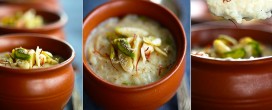
Peshawar’s White Badam Halwa: A Delicate, Old-World Indulgence
When we think of halwa, we often imagine a deep golden or brown preparation. But traditional kitchens across the north-western subcontinent have also cherished pale, delicately coloured sweets.
My version of White Badam Halwa takes inspiration from that understated style. The aim is to preserve the almond’s natural colour and delicate flavour rather than caramelise the mixture too deeply.
Blanched almonds, a gentle cooking temperature, and careful attention to the ghee help create a pale ivory halwa. Milk can be used to grind the almonds, although it makes the mixture more delicate and requires careful cooking.
This is a halwa of subtlety rather than drama. Its richness comes from almonds and ghee, while cardamom provides a gentle perfume.
The second preparation, Poppy Seed Halwa, offers a different expression of the same culinary tradition. Poppy seeds, known as khus khus, are soaked and ground before being cooked slowly with ghee, milk, and sugar. They produce a distinctive, nutty halwa with a smooth, almost velvety texture.
Both preparations reflect the beauty of traditional Indian mithai: a few carefully chosen ingredients, transformed through time and technique.
Although I cherish the family associations of these recipes, the versions below are my practical kitchen adaptations inspired by the traditional Peshawar-style preparations, rather than a claim that every household in Peshawar made them in exactly the same way.
Recipe 1: Moti Mahal-Inspired Badam Halwa
Preparation time: 20 minutes, plus soaking
Cooking time: 30–40 minutes
Serves: 4–6
Ingredients
- 250 g whole almonds
- 150–180 g sugar, according to taste
- 100–125 g ghee
- 150–200 ml milk, as required for grinding and cooking
- ½ teaspoon green cardamom powder
- A few strands of saffron, optional
- Slivered almonds or pistachios, for garnish
Method
- Soak the almonds. Cover the almonds with hot water and leave them for 30–45 minutes, or soak them in room-temperature water for several hours. Remove the skins and drain well.
- Grind to a paste. Blend the blanched almonds with a little milk until you obtain a fine, slightly grainy paste. Avoid adding too much liquid.
- Heat the ghee. In a heavy-bottomed kadai, warm the ghee over a low-to-medium flame.
- Cook the almond paste. Add the paste and stir continuously. Keep the heat moderate and scrape the bottom and sides of the pan frequently. The mixture should cook evenly without browning too quickly.
- Develop the flavour. Continue cooking for approximately 15–20 minutes, or longer if necessary, until the raw almond aroma disappears and the mixture becomes fragrant.
- Add the sugar. Stir in the sugar. The mixture may loosen as the sugar melts; this is normal.
- Finish the halwa. Add the remaining milk gradually, if needed, and continue stirring until the halwa thickens and the ghee begins to appear around the edges. Add cardamom and saffron.
- Serve warm. Garnish with slivered nuts and serve in small portions.
My kitchen tip: Do not rely on colour alone to judge doneness. A pale almond halwa can be fully cooked. Taste a small cooled portion to check that the raw almond flavour has disappeared.
Recipe 2: Peshawar-Style White Badam Halwa
This version aims for a delicate ivory colour and a softer almond flavour.
Preparation time: 20 minutes, plus soaking
Cooking time: 30–40 minutes
Serves: 4–6
Ingredients
- 250 g blanched almonds
- 125–150 g sugar
- 100 g ghee
- 150 ml warm milk, approximately
- ¼ teaspoon green cardamom powder
- 1 teaspoon rose water, optional
- A few slivered blanched almonds, for garnish
Method
- Soak the almonds and peel them carefully. Rinse and drain.
- Grind the almonds with a small quantity of milk to form a smooth paste.
- Heat the ghee in a heavy-bottomed pan over a low flame.
- Add the almond paste and cook gently, stirring constantly. Keep the mixture pale; avoid high heat or deep browning.
- Continue cooking until the paste smells nutty and no longer tastes raw.
- Add the sugar and stir as it dissolves. Add the remaining warm milk little by little.
- Cook until the mixture thickens into a soft, glossy halwa. Stir in cardamom and, if desired, rose water.
- Serve warm, garnished with blanched almonds.
The defining characteristic: This is not a white halwa because it contains a special whitening ingredient. Its pale appearance comes primarily from blanched almonds and gentle cooking.
Recipe 3: Peshawar-Style Poppy Seed Halwa
Poppy seeds have long been valued in traditional South Asian cooking for their nutty flavour and ability to create rich, distinctive preparations.
Preparation time: 20 minutes, plus soaking
Cooking time: 30–40 minutes
Serves: 4–6
Ingredients
- 150 g white poppy seeds (khus khus)
- 100–125 g sugar
- 100 g ghee
- 200–250 ml milk
- ¼ teaspoon green cardamom powder
- 1 tablespoon chopped almonds, optional
- A few strands of saffron, optional
Method
- Wash and soak. Rinse the poppy seeds thoroughly in a fine sieve. Soak them in warm water for 3–4 hours, or overnight in the refrigerator.
- Grind finely. Drain the seeds and grind them with a little milk or water to form a thick paste. Poppy seeds need sufficient grinding to achieve a smooth texture.
- Heat the ghee. Warm the ghee in a heavy-bottomed kadai over low-to-medium heat.
- Cook the paste. Add the ground poppy seeds and stir continuously. Cook patiently until the paste darkens slightly to a creamy beige and develops a rich, nutty aroma.
- Add milk. Pour in the milk gradually, stirring to prevent lumps. Allow the mixture to cook until the liquid is absorbed and the paste thickens.
- Sweeten. Add the sugar and continue stirring. The mixture may loosen before thickening again.
- Finish. Add cardamom and saffron, if using. Cook until the halwa becomes glossy and begins to leave the sides of the pan.
- Serve. Garnish with chopped almonds and serve warm.
My kitchen tip: Poppy seed halwa needs patience and a heavy pan. If the paste catches at the bottom, reduce the heat immediately and stir in a small splash of warm milk. Do not rush the cooking by turning up the flame.
How to Serve These Traditional Halwas
At home, I would serve all three halwas in small portions, allowing their different flavours to stand out.
- Badam Halwa: Serve warm, with slivered almonds and a few strands of saffron.
- White Badam Halwa: Pair with a light garnish of blanched almonds and a delicate touch of rose water.
- Poppy Seed Halwa: Serve warm with chopped nuts and cardamom.
These preparations are rich, so a small serving is usually sufficient after a generous Indian meal. For a festive presentation, offer them together as a trio of traditional halwas, each with its own colour, aroma, and texture.
Preserving the Culinary Heritage of Our Grandparents
As someone who has devoted much of his life to carrying forward the legacy of Moti Mahal, I believe that preserving Indian food heritage requires more than documenting famous dishes. We must also remember the home cooking, the family favourites, and the techniques that were passed from one generation to the next.
My grandfather, Kundan Lal Gujral, taught me that culinary excellence comes from understanding food rather than merely following instructions. His legacy continues to inspire me, whether I am exploring the history of a celebrated dish, teaching culinary students, writing a cookbook, or recreating a traditional recipe in my own kitchen.
Badam Halwa brings all these memories together. It connects me to my grandfather, to the stories of his mother, Moghe Maya Devi, and to a culinary world in which food was prepared with patience and served with generosity.
Every time I prepare this halwa, I am reminded that our greatest inheritance is not simply a collection of recipes. It is the knowledge, memories, and affection that give those recipes meaning.
And perhaps that is the sweetest lesson of all: a dish becomes a legacy when it is cooked, shared, remembered, and passed on.
— Monish Gujral
Restaurateur, author, and custodian of the Moti Mahal culinary heritage
)