There are few foods in the world as democratic as the hamburger.
A burger can be eaten in a five-star restaurant or from a roadside food truck. It can be made with beef, chicken, fish, vegetables, beans—or, in my kitchen, millets and chickpeas.
What fascinates me as a chef is that behind this seemingly simple sandwich is a story of migration, invention and adaptation.
And perhaps that is why I love the hamburger.
It is not really one person’s invention.
It is a food that evolved.
Where did the hamburger actually come from?
The name takes us to Hamburg, Germany, and to a preparation known as Hamburg steak.
In nineteenth-century America, Hamburg steak was associated with minced or chopped beef prepared in the German style. Detailed American recipes appeared in cookbooks by the 1870s and 1880s. One 1884 recipe described pounding beef with onions, seasoning it and broiling it.
But a Hamburg steak was not yet a hamburger.
The great transformation came when ground meat met bread.
And this is where the history becomes wonderfully messy.
Several American towns and cooks claim to have invented the hamburger in the late nineteenth or early twentieth century. There are stories from Seymour, Wisconsin; Athens, Texas; New Haven, Connecticut; and other places.
Some say it happened at a fair, where a cook needed to give a customer something portable to eat while walking.
That makes perfect culinary sense to me.
Food often changes because of convenience.
People are walking.
They are hungry.
They don’t want a knife and fork.
So someone takes the patty and puts it between bread.
And suddenly, you have a hamburger.
Historians generally agree that the modern hamburger emerged through this evolution rather than from one conclusively documented inventor. The claims of invention cluster around the period from about 1885 to 1904.
The hamburger is really a story about travel
This is what I find most beautiful about food history.
The hamburger’s name carries a German connection, but its modern identity was shaped in America.
It travelled.
It adapted.
It became fast food.
Then it became gourmet food.
And today, almost every country has its own interpretation.
As someone who has spent my life exploring Indian culinary traditions, I see the same thing happening everywhere.
When food travels, it does not remain unchanged.
It absorbs the culture around it.
That is how cuisines evolve.
My own Indian interpretation
I have always believed that Indian cooking has an enormous vocabulary of grains, pulses, vegetables and spices that can transform international foods.
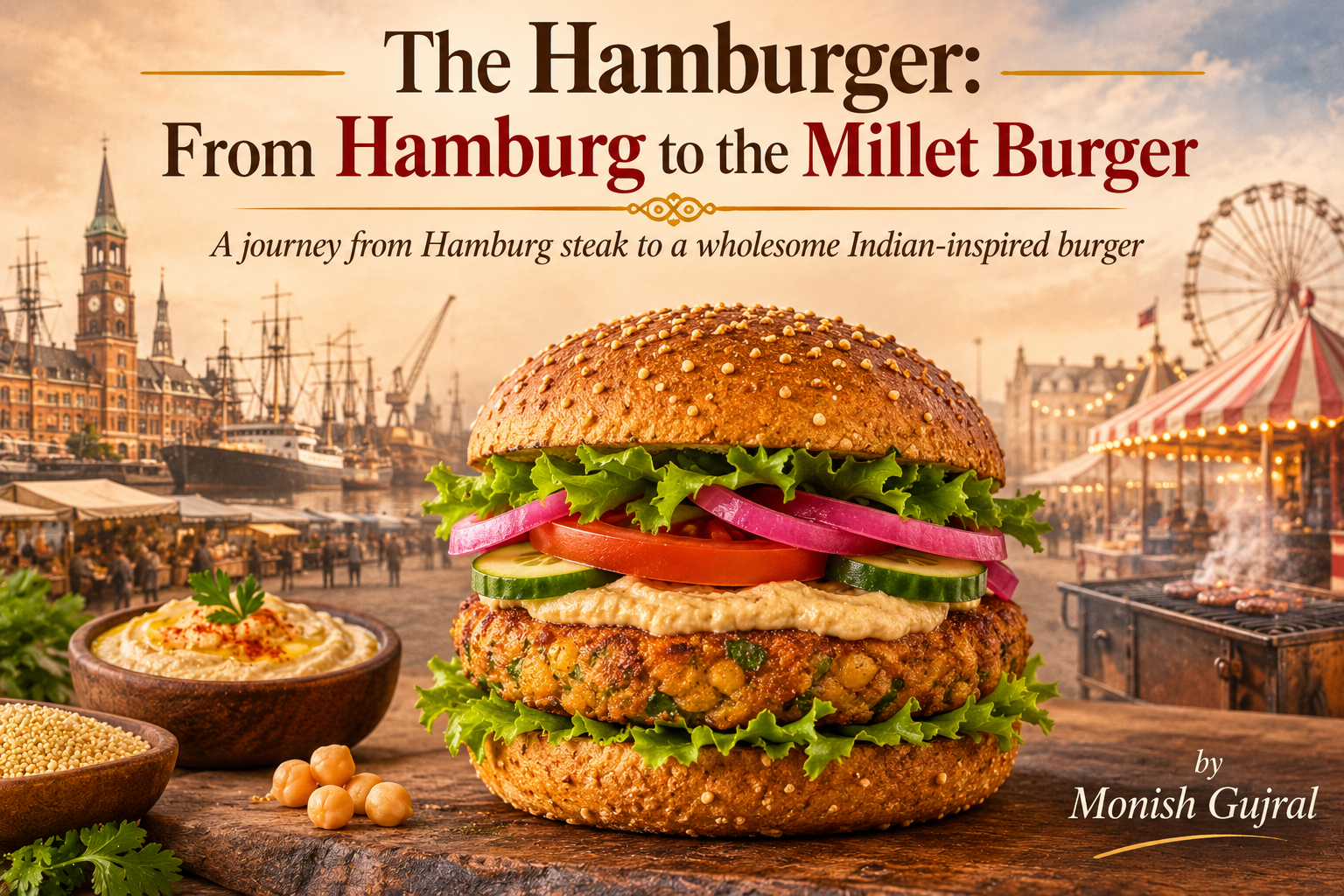
And that is what inspired my Millet Bun Burger with Chickpea Patty and Hummus.
Instead of a refined-flour bun, I use millets.
Instead of meat, I use the humble but extraordinary chickpea.
And instead of a heavy sauce, I use creamy hummus, made from the same family of ingredients that form the heart of the patty.
It is a burger—but it is also unmistakably Indian in spirit.
The millet gives the bun a wonderful earthy character.
The chickpea provides body and protein.
The hummus brings creaminess.
And then come the fresh vegetables, pickles and herbs to give the burger crunch and acidity.
It is a reminder that healthy food doesn’t have to be boring.
My Millet Bun Burger
For the millet buns
Ingredients
- 1 cup millet flour
- ½ cup whole-wheat flour
- 1 teaspoon instant yeast
- 1 teaspoon sugar or jaggery
- ½ teaspoon salt
- 1 tablespoon olive oil
- Approximately ¾ cup warm water, as required
- 1 tablespoon sesame seeds
Method
Mix the millet flour, whole-wheat flour, yeast, sugar and salt.
Add the olive oil and gradually add warm water, kneading until you have a soft dough.
Millet contains no gluten, so the addition of whole-wheat flour helps give the bun structure. Do not expect the dough to behave exactly like a conventional wheat-bread dough.
Cover and allow it to rise until approximately doubled.
Divide into portions and shape into round buns.
Place on a baking tray, brush lightly with water or milk and sprinkle with sesame seeds.
Bake at 180°C for approximately 18–22 minutes, until lightly golden and cooked through.
Allow to cool before slicing.
Chickpea Patty
Ingredients
- 1½ cups cooked chickpeas
- 1 small onion, finely chopped
- 1 small carrot, grated
- 1 green chilli, finely chopped
- 2 tablespoons coriander, chopped
- 1 teaspoon roasted cumin powder
- ½ teaspoon red chilli powder
- ½ teaspoon garam masala
- 1 teaspoon lemon juice
- Salt to taste
- 2–3 tablespoons millet flour or roasted gram flour
- 1 tablespoon olive oil for cooking
Method
Mash the chickpeas coarsely. I prefer not to make them completely smooth—the little pieces of chickpea give the patty character.
Add onion, carrot, green chilli, coriander, cumin, chilli powder, garam masala, lemon juice and salt.
Mix in enough millet flour or roasted gram flour to bind the mixture.
Shape into firm patties.
Heat a little olive oil in a pan and cook the patties over medium heat until golden and crisp on both sides.
The secret is not to make the patty too wet. It should hold together firmly while remaining moist inside.
Hummus
Ingredients
- 1 cup cooked chickpeas
- 2 tablespoons tahini
- 1 garlic clove
- 2 tablespoons lemon juice
- 2 tablespoons extra-virgin olive oil
- Salt to taste
- 2–4 tablespoons cold water
- A pinch of roasted cumin powder
Blend everything until smooth and creamy.
Add cold water little by little until you reach the consistency you like.
I like my hummus silky enough to spread generously on the bun.
Building the burger
Toast the millet bun lightly.
Spread a generous layer of hummus on the bottom half.
Place the hot chickpea patty on top.
Add:
- Crisp lettuce
- Tomato slices
- Cucumber
- Pickled onions
- Fresh coriander
- A few slices of jalapeño, if you like heat
Finish with another spoonful of hummus and place the top bun over it.
Then comes the most important part.
Eat it while the patty is hot and the bun is still warm.
Why I call this my burger
Every chef eventually reaches a point where recipes stop being about copying and start being about interpretation.
That is how I approach food.
I don’t want to erase the history of a dish.
I want to understand it first—and then give it my own identity.
The hamburger began its journey through Hamburg steak and became an American icon. Today it can travel again, this time into an Indian kitchen, where millet, chickpeas, coriander, cumin and hummus give it a completely different personality.
That is the beauty of food.
A recipe can travel thousands of miles without losing its soul. It simply acquires another chapter.
And perhaps my millet burger is just that:
another chapter in the very long story of the hamburger.
From Hamburg to America.
From beef to vegetables.
From refined flour to ancient grains.
From a simple sandwich to a celebration of global food.
Because, as I have always said, food has no borders.
It only has stories.