Growing up in the bustling, sensory-rich kitchens of Moti Mahal, my culinary education wasn’t just about mastering recipes—it was a deep dive into the living history of food. My grandfather, Kundan Lal Gujral, was a man who commanded the tandoor like an artist commands a canvas. When he taught me how to cook, he didn’t just pass down techniques; he passed down stories.
I vividly remember standing beside him as a young boy, the heat of the tandoor warming our faces, as he watched me handle ingredients. If I rushed, he would gently tap my shoulder and say, “Monish, food requires patience. Every grain of rice, every spice has a lineage. Respect its journey.”
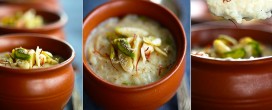
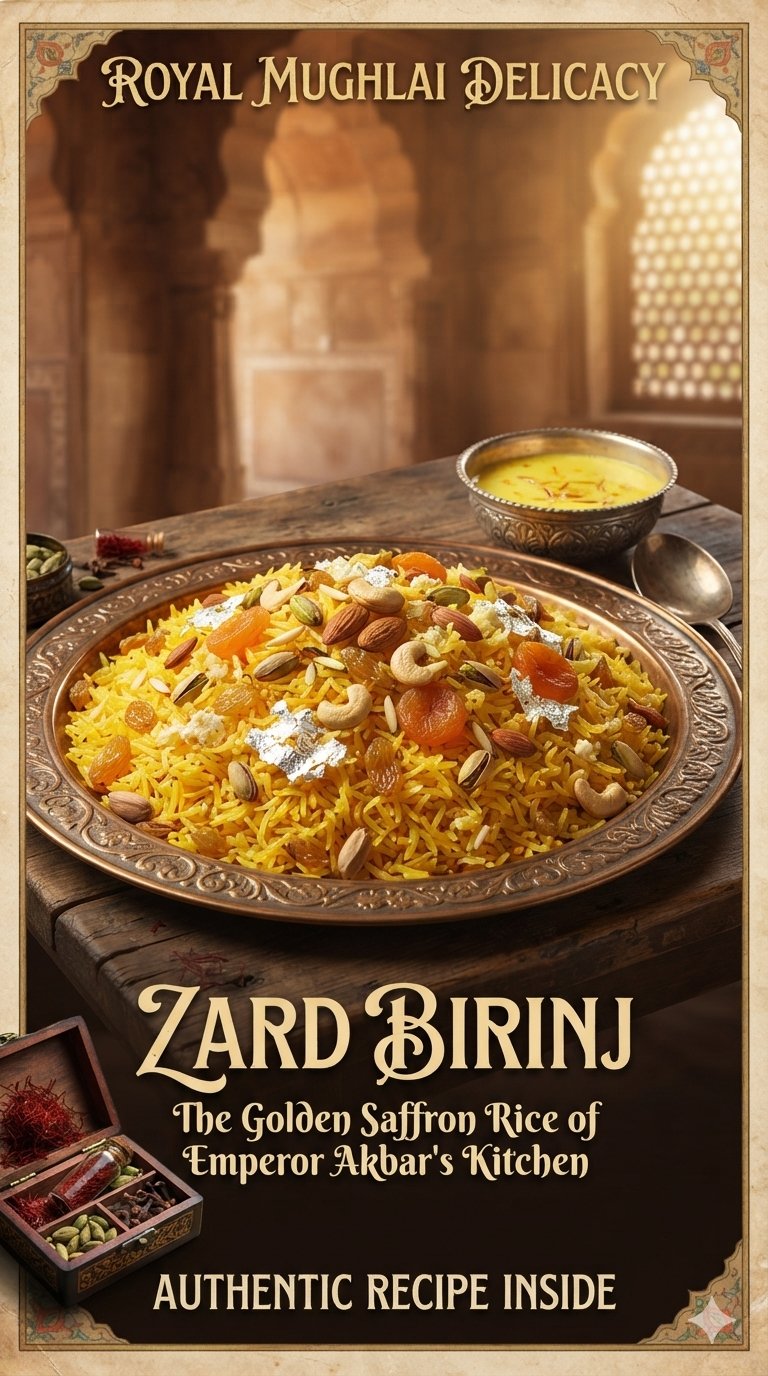
That profound lesson stayed with me. It is what ultimately drove me to become a food history writer and researcher. Years spent digging through ancient culinary texts and tracing the roots of subcontinental dishes have brought me to one of my absolute favorite discoveries: the true story behind Zarda, that vibrant, sweet, saffron-infused rice that graces our festive tables today. Long before it became a wedding staple, it was known as Zard Birinj, and it is said to be invented inside the imperial kitchens of Emperor Akbar.
👑 The Imperial Discovery: A “Sufiyana” Masterpiece
In my personal research into Mughal culinary chronicles, I spent considerable time analyzing the Ain-i-Akbari, the monumental 16th-century administrative document penned by Akbar’s grand vizier, Abu’l-Fazl. It is here that we find the earliest, most meticulous record of Zard Birinj (derived from the Persian Zard meaning yellow, and Birinj meaning rice).
What fascinates me most as a historian is how Abu’l-Fazl categorizes this dish. It isn’t placed alongside the heavy, opulent meat curries. Instead, Zard Birinj is explicitly listed under Sufiyana foods. These were the highly prestigious, meatless delicacies consumed by Emperor Akbar during his extensive periods of spiritual fasting and self-abstinence. Akbar avoided meat sometimes, , challenging his royal chefs to elevate vegetarian and sweet dishes to unparalleled heights.
The original imperial recipe recorded in the text is a testament to royal luxury:
- 10 seers of premium quality rice
- 5 seers of sugar candy (mishri)
- 3.5 seers of pure desi ghee
- A lavish infusion of pure saffron
- Fresh ginger and cinnamon
By blending the Persian culinary sensibilities brought over by his father Humayun’s court with local Indian ingredients, Akbar’s chefs successfully birthed a dessert legend.
👩🍳 Recipe: Shahi Zard Birinj (The Gujral Family Adaptation)
When I recreated this historical dish at home, I brought in the core principles of slow-cooking my grandfather, Kundan Lal, taught me at Moti Mahal. This modern adaptation honors the exact 16th-century flavour profile—complete with a brilliant “secret” historical ingredient that modern variations completely left behind.
- Prep Time: 30 minutes (plus 1 hour soaking)
- Cook Time: 30 minutes
- Servings: 6-8 servings
- Course: Dessert / Festive Royal Sweet
🛒 Ingredients
For the Rice Base:
- 2 cups Long-grain Basmati rice (soaked for 1 hour)
- 1 tsp Pure saffron threads (soaked in 2 tbsp warm milk)
- 1/2 tsp Yellow or deep orange food coloring (to honor the imperial hue)
- 4-5 Whole green cardamoms
- 2 Small sticks of cinnamon
- 6-7 cups Water (for boiling)
For the Sweetness & Aromatic Base:
- 1.5 cups White sugar or crushed sugar candy (mishri)
- 1/2 cup Pure desi ghee
- 1 tsp Fresh ginger, finely julienned (The historical secret!)
- 1/2 cup Warm water or whole milk
- 1 tsp Kewra water or rose water
For the Shahi Garnish:
- 2 tbsp Almonds (blanched, peeled, and slivered)
- 2 tbsp Pistachios (slivered)
- 2 tbsp Golden raisins
- 50g Khoya/Mawa (crumbled, optional for modern richness)
🥣 Step-by-Step Instructions
Step 1: Parboil the Fragrant Rice
- Bring 6-7 cups of water to a rolling boil in a large pot along with the green cardamoms and cinnamon sticks.
- Stir in the yellow/orange food coloring.
- Drain your soaked rice and add it to the boiling water.
- Cook on high heat until the rice is 80% done (parboiled)—the grains must have a firm bite right in the center (ek kani). As my grandfather used to warn me, “Overcooked rice is the death of a good biryani or sweet pilaf.”
- Drain the rice completely through a sieve and set aside.
Step 2: Fry the Royal Elements
- Melt the desi ghee in a heavy-bottomed pan or handi over a medium flame.
- Add the slivered almonds, pistachios, and raisins. Fry gently for 1 minute until the nuts turn lightly golden and raisins plump up. Remove half of them and save for the final garnish.
- In the remaining ghee left in the pan, add the julienned ginger and fry for 30 seconds until highly aromatic.
Step 3: Create the Sugar Syrup Base
- Lower the heat and add your sugar (or sugar candy) along with 1/2 cup of milk or water.
- Stir continuously on medium heat until the sugar melts completely into a smooth, bubbling syrup.
Step 4: Combine and Dum Cook
- Gently slide the yellow parboiled rice into the bubbling sugar syrup. Mix with an incredibly light hand to avoid breaking the delicate long grains.
- Drizzle the saffron-infused milk and kewra water evenly over the top of the rice.
- Cook on medium-high heat for 2-3 minutes until most of the liquid evaporates from the edges.
- Seal the pot tightly with a lid (wrap the lid in a clean kitchen towel to trap the steam perfectly).
- Turn the heat to its absolute lowest setting and let it cook on Dum (slow steam) for 12–15 minutes.
Step 5: The Royal Finish
- Turn off the heat and let the pot sit undisturbed for 5 minutes.
- Remove the lid and fluff the rice gently with a fork to let the steam release.
- Garnish with the reserved fried nuts, raisins, and crumbled khoya. Serve warm!
💡
My Historical Note & Kitchen Secret
Most modern Zarda recipes rely strictly on cardamoms and kewra water. However, my research into the imperial archives highlighted a fascinating element: fresh ginger.
When I first tested adding julienned ginger to the ghee, it felt experimental, but the result was breathtaking. The ginger beautifully cuts through the heavy sweetness of the sugar and richness of the ghee. It provides a sharp, sophisticated undertone that elevates this dish from a simple street sweet to a true palace delicacy. I know if my grandfather were here today, he would taste it, smile, and nod in absolute approval.
Have you ever tried adding a hint of ginger to your sweet dishes? Let me know in the comments below, and let’s keep the conversation on food history alive!