By Monish Gujral
A sweet story of Indian kitchens, tradition and indulgence
There is something magical about traditional Indian mithai. Long before glossy sweet-shop counters and beautifully packaged confectionery became fashionable, our grandmothers and traditional halwais were creating sweets that relied on patience, skill and a deep understanding of ingredients. For me, balushahi is one such timeless delicacy—a sweet that proves that simplicity, when combined with craftsmanship, can create something truly extraordinary.
As someone who has spent a lifetime exploring Indian culinary heritage, I have always been fascinated by how our traditional sweets evolved. Every mithai has a story, whether it is associated with a royal kitchen, a festive celebration, a family ritual or the ingenuity of a halwai who understood the science of flour, ghee and sugar.
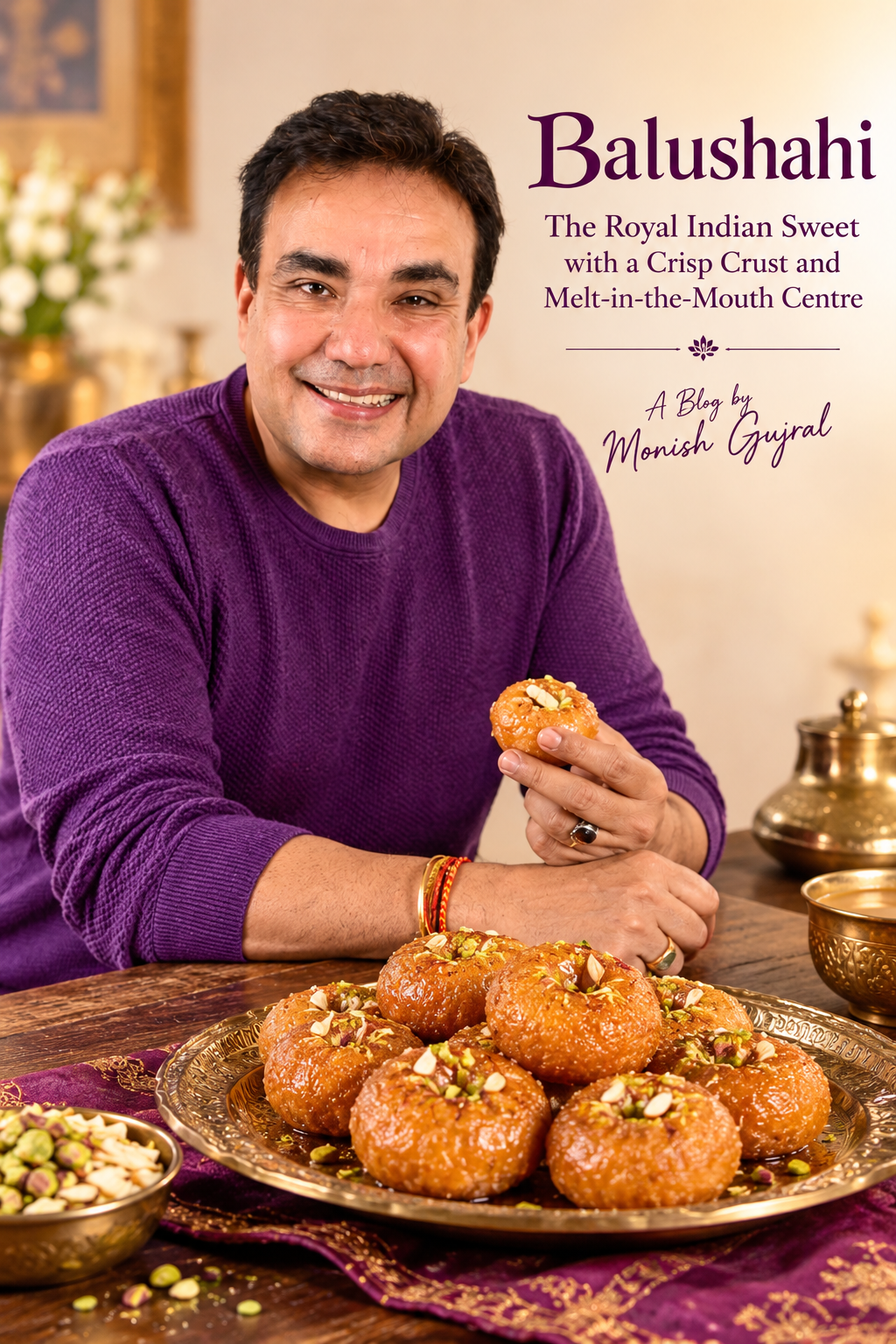
Balushahi has always intrigued me because of its beautiful contrast of textures. Its golden, slightly flaky crust gives way to a soft, tender interior, while a delicate coating of sugar syrup lends it the sweetness that makes it so irresistible.
The origins of balushahi: A sweet with a rich culinary heritage
Balushahi is a traditional Indian sweet particularly popular across North India, especially in Uttar Pradesh, Rajasthan, Delhi and the surrounding regions. It is also enjoyed in different forms across the subcontinent, including the closely related badusha of South India.
Although the precise inventor and date of its creation are not firmly documented, balushahi belongs to the long tradition of South Asian fried sweets made with flour, fat and sugar syrup. Its resemblance to certain Central Asian and Middle Eastern pastries has inspired comparisons, but it would be inaccurate to attribute its invention to a single person or kitchen without historical evidence.
What fascinates me is the technique behind it. Unlike a gulab jamun, which is generally soft and spongy, balushahi is designed to have a delicate, layered texture. The secret lies in incorporating ghee into the flour, handling the dough gently and frying the pieces slowly at a relatively low temperature.
The result is a sweet that is crisp on the outside, delicately flaky within and soaked in just enough syrup to create a wonderful balance.
My culinary reflections: Why traditional mithai deserves to be preserved
In my culinary journey, I have repeatedly found that the most memorable dishes are often the ones that require the least embellishment. Whether it is a traditional Indian curry or an age-old sweet, authenticity comes from respecting the ingredients and the technique.
At Moti Mahal, our culinary philosophy has always centred on preserving the character of India’s food traditions while making them accessible to new generations. My grandfather, Kundan Lal Gujral, demonstrated how a culinary legacy can travel across generations and borders without losing its identity.
I see the same value in traditional mithai. Balushahi does not need elaborate decoration or exotic ingredients. Good-quality flour, pure ghee, a little yoghurt and properly prepared sugar syrup are enough. Yet, getting the texture right requires care and patience.
I particularly enjoy the idea of preparing balushahi at home. The aroma of ghee as the dough slowly turns golden, followed by the gentle sweetness of the syrup, brings back the warmth of traditional Indian kitchens, where food was prepared thoughtfully rather than hurriedly.
For anyone attempting balushahi for the first time, my advice is simple: do not rush the frying. A beautiful golden colour on the outside does not necessarily mean the centre is cooked. Give the sweet time to develop its characteristic flaky texture.
And remember, a little imperfection in its shape is part of its homemade charm!
My simple homemade balushahi recipe
This is an easy, home-friendly version that uses readily available ingredients and does not require any special equipment.
Preparation time: 20 minutes
Resting time: 20–30 minutes
Cooking time: 30–40 minutes
Makes: Approximately 10–12 pieces
Ingredients
For the balushahi
- 2 cups (250 g) maida (all-purpose flour)
- ¼ cup (60 g) ghee, chilled or at room temperature
- ¼ cup thick yoghurt, approximately
- ¼ teaspoon baking soda
- A pinch of salt
- 2–4 tablespoons cold water, only if needed
- Ghee or neutral oil, for frying
For the sugar syrup
- 1 cup sugar
- ½ cup water
- ¼ teaspoon cardamom powder
- A few strands of saffron, optional
- 1 teaspoon lemon juice, optional, to help prevent crystallisation
For garnish
- A few chopped pistachios or almonds, optional
Method
1. Prepare the dough
In a large bowl, combine the flour, baking soda and salt. Add the ghee and rub it gently into the flour with your fingertips until the mixture resembles coarse breadcrumbs.
Add the yoghurt gradually and bring the mixture together into a soft, slightly crumbly dough. Add a little cold water only if necessary. Do not knead it like bread dough; overworking it can make the balushahi hard.
Cover and rest for 20–30 minutes.
2. Shape the balushahi
Divide the dough into 10–12 equal portions. Gently roll each portion into a ball, flatten it slightly and make a small indentation in the centre with your thumb.
Avoid making the dough too smooth or compact. Gentle handling helps create the delicate texture that makes a good balushahi special.
3. Fry slowly
Heat ghee or oil in a deep, heavy-bottomed pan over low heat. The fat should be warm but not smoking.
Add a few balushahis at a time. Fry them slowly, turning occasionally, until they become evenly golden. This may take around 15–20 minutes per batch, depending on their size and the temperature.
If the oil is too hot, they will brown on the outside while remaining undercooked inside. Maintain a gentle, steady temperature.
Remove the balushahis and let excess fat drain away.
4. Prepare the sugar syrup
Combine the sugar and water in a saucepan. Heat until the sugar dissolves, then simmer until the syrup becomes slightly sticky and reaches approximately one-string consistency.
Stir in the cardamom powder and saffron, if using. Add the lemon juice, if desired.
The syrup should be warm and coating, rather than excessively thick or caramelised.
5. Dip and coat
Allow the fried balushahis to cool slightly. Dip them into the warm syrup for around 2–3 minutes, turning gently so that they are coated evenly.
Remove them with a slotted spoon and place them on a plate or wire rack. Allow the syrup coating to set.
Garnish with chopped pistachios or almonds if you like.
Your homemade balushahi is ready to serve!
My tips for the perfect balushahi
- Do not over-knead: A gently mixed dough produces a more delicate result.
- Keep the fat temperature low: Slow frying is the key to cooking the centre without burning the crust.
- Be patient: Large balushahis need time to cook through.
- Watch the syrup: A syrup that is too thin will not coat properly, while one that is too thick may crystallise.
- Allow the coating to set: The texture improves as the syrup dries on the surface.
Store the completely cooled sweets in an airtight container in a cool, dry place and enjoy them within several days for the best quality.
The sweetness of our culinary heritage
For me, balushahi represents more than a traditional Indian dessert. It is a reminder of the knowledge preserved in our kitchens and the skill of generations of halwais who perfected their craft through experience.
In today’s fast-paced world, there is something deeply satisfying about returning to such recipes. They encourage us to slow down, respect the process and appreciate the flavours that have been part of our food culture for generations.
Whether served during Diwali, at a family gathering or simply alongside a cup of chai, balushahi remains a sweet that brings people together.
As I continue to explore and document India’s culinary heritage, I believe that preserving these traditional recipes is as important as celebrating our famous curries and regional specialities. Every sweet has a place in our gastronomic story, and balushahi certainly deserves its place at the table.
After all, some of India’s finest culinary treasures are not complicated creations. They are simple recipes, perfected over generations, and made memorable by the love and patience that go into preparing them.
— Monish Gujral
Restaurateur, chef, cookbook author and custodian of Indian culinary heritage