By Monish Gujral
India’s festivals are deeply intertwined with its history, spirituality and culinary traditions. Few celebrations reflect this beautiful relationship as profoundly as Navratri, the nine sacred nights dedicated to the worship of Goddess Durga and her many manifestations. For me, as someone who has spent a lifetime exploring India’s culinary heritage, festivals such as Navratri offer a wonderful opportunity to discover how faith, seasonal ingredients and traditional cooking have shaped our food culture over centuries.
Navratri is not merely a festival of prayer and fasting. It is also a celebration of renewal, discipline, family traditions and the extraordinary diversity of Indian cuisine.
The historical origins and dates of Navratri
The word Navratri comes from the Sanskrit words nava, meaning nine, and ratri, meaning night. Although there are four Navratris observed during the Hindu lunar year, two are particularly prominent: Chaitra Navratri, celebrated in spring, and Sharad Navratri, celebrated in autumn.
Chaitra Navratri begins on the first day of the bright fortnight of the Hindu month of Chaitra, generally falling in March or April. It culminates in Ram Navami, commemorating the birth of Lord Rama.
Sharad Navratri begins on Ashwin Shukla Pratipada, the first day of the bright fortnight of the Hindu month of Ashwin, usually in September or October. The festival concludes on the ninth day, known as Maha Navami, followed in many regions by Vijayadashami or Dussehra on the tenth day.
Because these celebrations follow the traditional lunar calendar, their dates change each year in the Gregorian calendar.
The roots of Navratri are associated with ancient Hindu religious traditions, goddess worship and seasonal celebrations. The Devi Mahatmya, a celebrated section of the Markandeya Purana, narrates the triumph of Goddess Durga over the buffalo demon Mahishasura. This victory represents the triumph of righteousness over evil and divine strength over destructive forces.
Over centuries, Navratri developed distinctive regional traditions. In Gujarat, devotees celebrate with Garba and Dandiya Raas; in West Bengal, Durga Puja commemorates the Goddess’s arrival and victory; in northern India, the festival is closely associated with the Ramayana and the burning of Ravana’s effigies on Dussehra. In southern India, traditions such as Golu, featuring displays of dolls and figurines, bring families together in devotion.
These different celebrations reveal how one festival can unite India while allowing each region to preserve its own identity.
The nine forms of Goddess Durga
Navratri is traditionally dedicated to the nine forms of the Goddess, collectively known as Navadurga:
- Shailputri
- Brahmacharini
- Chandraghanta
- Kushmanda
- Skandamata
- Katyayani
- Kalaratri
- Mahagauri
- Siddhidatri
Each form represents a different aspect of feminine power, courage, compassion, wisdom or spiritual fulfilment. Devotees observe prayers, maintain fasts and make offerings according to their family and regional traditions.
For many households, fasting is an important part of the observance. Yet fasting does not necessarily mean going without food. Instead, people follow particular dietary practices, avoiding grains such as wheat and conventional rice while choosing permitted ingredients such as fruit, milk, nuts, potatoes, buckwheat and water-chestnut flour.
One particularly interesting ingredient in this culinary tradition is samak ke chawal, often called vrat rice or barnyard millet. Despite its name and rice-like appearance, it is a millet rather than true rice. Its small grains can be cooked into khichdi, pulao and even creamy desserts.
And that brings me to a festive recipe that is simple, elegant and delicious.
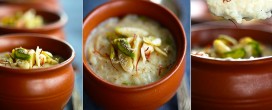
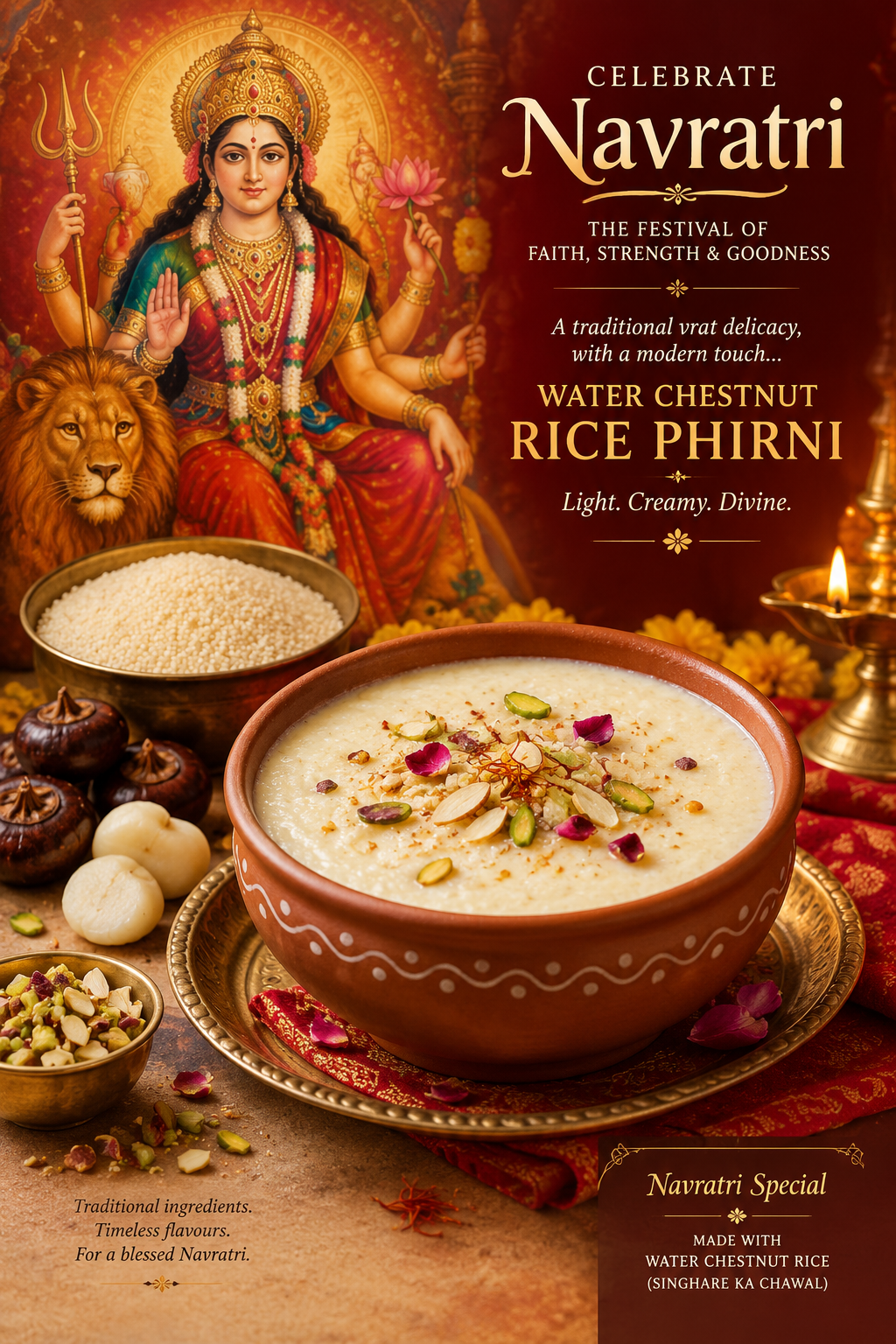
Navratri Special: Water Chestnut and Vrat Rice Phirni
Ingredients
Serves 4
- ½ cup samak ke chawal (barnyard millet or vrat rice)
- ½ cup fresh or boiled water chestnuts (singhara), peeled and finely grated or chopped
- 1 litre full-fat milk
- 4–5 tablespoons sugar, or to taste
- ½ teaspoon green cardamom powder
- 10–12 almonds, finely slivered
- 10–12 pistachios, chopped
- A few strands of saffron
- 1 teaspoon warm milk for soaking the saffron
- 1 teaspoon ghee, optional
- Dried rose petals for garnish, optional
Method
1. Prepare the vrat rice
Wash the samak rice thoroughly, drain and grind it coarsely. Keep aside.
2. Prepare the water chestnuts
Peel the water chestnuts and grate them finely or chop them into very small pieces. If using whole fresh water chestnuts, boil them until tender before peeling and chopping. If using ready-to-eat boiled water chestnuts, drain them well.
3. Simmer the milk
Bring the milk to a gentle boil in a heavy-bottomed pan. Lower the heat and simmer for a few minutes, stirring occasionally.
4. Cook the rice and water chestnuts
Add the coarsely ground samak rice gradually to the milk, stirring continuously to prevent lumps. Cook on a low flame for about 15–20 minutes, or until the millet is soft and the milk begins to thicken.
Add the grated or finely chopped water chestnuts and cook for another 8–10 minutes, stirring regularly, until they are tender and their flavour blends into the milk. If the mixture becomes too thick, add a little hot milk.
5. Add sweetness and fragrance
Stir in the sugar, cardamom powder and saffron soaked in warm milk. Add most of the almonds and pistachios, reserving some for the garnish. Simmer for another 2–3 minutes.
6. Chill the phirni
Switch off the heat when the phirni is creamy but still slightly pourable, as it will thicken while cooling. Pour into individual earthenware bowls and allow to cool. Refrigerate for at least two hours.
7. Garnish and serve
Garnish with the remaining nuts and dried rose petals. Serve chilled as a special Navratri dessert.
Chef’s tip
The water chestnuts add a delicate sweetness and a subtle crunch, while samak rice provides the creamy body traditionally associated with phirni. For a smoother finish, grate the water chestnuts finely; for more texture, chop them into tiny pieces.
Use ingredients and utensils that comply with your family’s Navratri fasting customs.
My chef’s tips
- For a smoother texture: Grind the samak rice finely, but not into a completely smooth flour.
- For richer flavour: Use full-fat milk and allow it to simmer gently rather than boiling it vigorously.
- For a festive touch: Add a few strands of saffron and garnish with pistachios and rose petals.
- For fasting requirements: Check that all ingredients, including flavourings and any optional additions, meet your family’s vrat rules. Use a clean pan and utensils reserved for fasting food if that is your household’s practice.
Navratri and the culinary heritage of India
As I reflect on festivals such as Navratri, I am reminded that Indian cuisine has never been static. It has evolved through regional customs, royal kitchens, household ingenuity and the wisdom of generations who understood how to make the best use of seasonal produce.
At Moti Mahal, my grandfather, Kundan Lal Gujral, helped shape an important chapter in India’s culinary history through the tandoor and dishes that subsequently travelled across the world. My own journey as a chef, restaurateur and food writer has reinforced my belief that preserving culinary heritage does not mean refusing to innovate. It means respecting the foundations of a dish while allowing it to find a place in contemporary kitchens.
A vrat rice phirni may be a modest dessert, but it represents this very philosophy. A traditional cooking technique meets an ingredient suited to a particular religious observance, creating something comforting and relevant for today’s table.
As families gather to pray, fast and celebrate during Navratri, I hope this recipe brings a little sweetness to their festivities.
May these nine sacred nights inspire strength, compassion, prosperity and harmony in every home.
Shubh Navratri!
— Monish Gujral, Restaurateur, Chef and Author