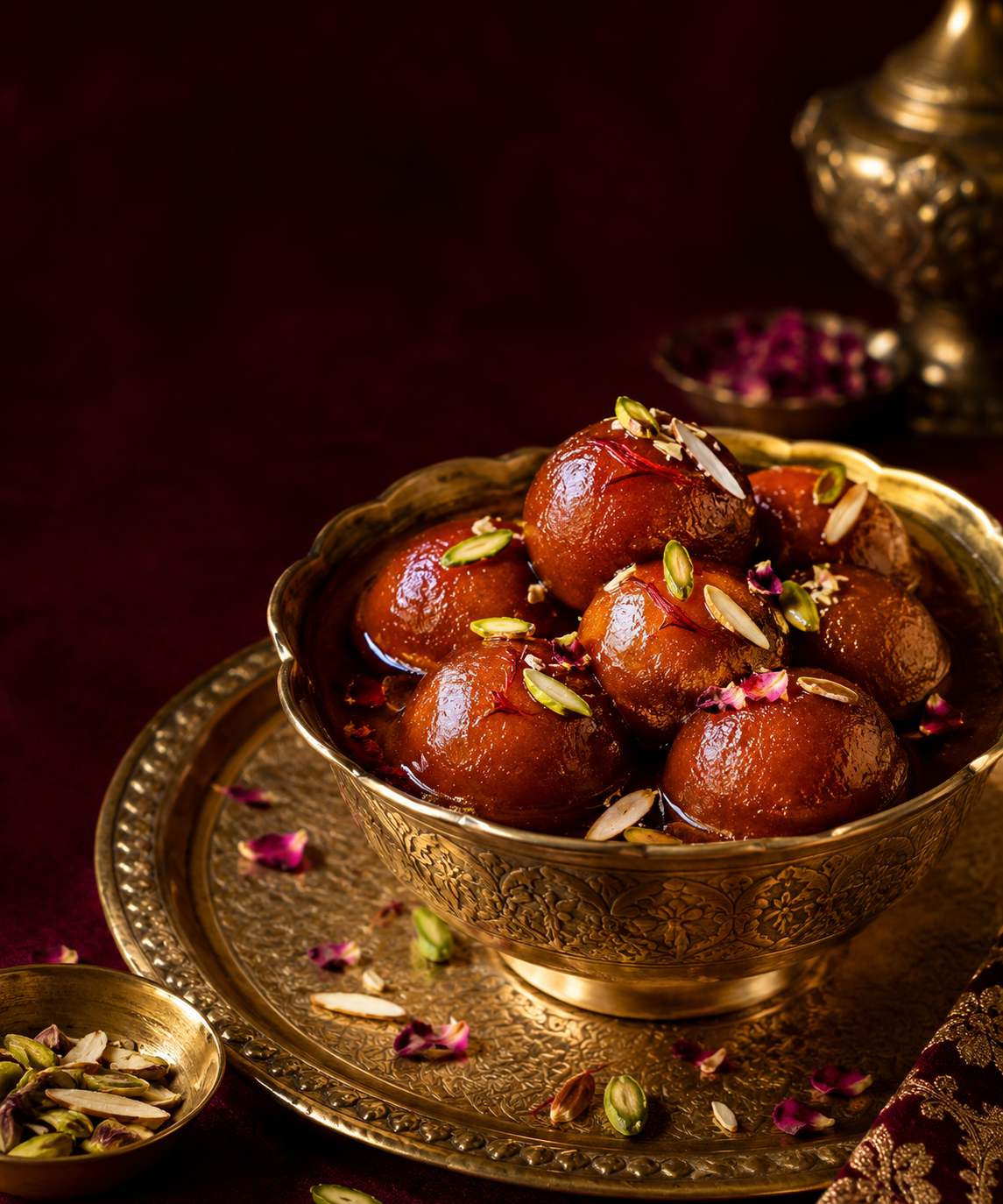
Long before gulab jamun became the beloved mithai of Indian weddings, festivals and royal feasts, its story is believed to have travelled across the ancient Persian and Central Asian world.
There were already sweets in the region made from small balls of dough or milk solids, fried until golden and then soaked in honey or sweetened syrup. One such Middle Eastern preparation, luqmat-al-qadi, is documented centuries before the Mughal period. Over time, such culinary traditions travelled with traders, travellers and Central Asian rulers towards the Indian subcontinent.
But India has its own delicious legend.
The story takes us to the magnificent court of Emperor Shah Jahan, where the royal kitchens of the Mughal court were renowned for their elaborate dishes, fragrant spices, nuts, saffron, rosewater and culinary experimentation. Historical research confirms that the imperial kitchen was an exceptionally sophisticated operation, with cooks constantly creating and refining dishes for the emperor’s table.
According to the popular legend, one day a royal cook was preparing a rich milk-based sweet. In the bustle of the imperial kitchen, the mixture was shaped into little balls and fried. Rather than serving them dry, the cook decided to immerse the fried balls in a fragrant syrup perfumed with rosewater and cardamom.
The result was unexpected.
The little fried balls absorbed the fragrant syrup, becoming soft, succulent and wonderfully rich inside. Their deep brown colour and rounded shape reminded the court of the jamun, the dark purple Indian fruit. The rose-scented syrup gave the creation its other half of the name — gulab, from gul-ab, associated with rose and rose-scented water.
And so, according to the legend, a royal kitchen accident became a delicacy fit for an emperor.
There is, however, an important distinction between legend and documented history: no reliable historical source has established the name of Shah Jahan’s chef or conclusively proved that gulab jamun was invented in his kitchen. Modern food historians generally regard the Shah Jahan story as one of several origin traditions surrounding a sweet with much older Persian, Middle Eastern and Central Asian connections.
Perhaps that uncertainty makes the story even more beautiful.
For what is the history of Indian cuisine if not the story of ingredients travelling across kingdoms, being transformed by Indian kitchens and becoming something entirely new?
A Royal-Style Gulab Jamun
For a version inspired by the richness of a Mughal royal kitchen, use khoya, chenna, saffron, green cardamom, rosewater and pistachios.
For the Jamun
- 1½ cups fresh khoya/mawa
- ¼ cup fresh chenna or soft paneer
- 3 tbsp refined flour
- ¼ tsp baking soda
- ¼ tsp green cardamom powder
- 1 tbsp finely chopped pistachios
- A few strands of saffron
- Ghee, for frying
For the Royal Chashni
- 2 cups sugar
- 2 cups water
- 4–5 green cardamoms, lightly crushed
- A generous pinch of saffron
- 1–2 tsp rosewater
- A few drops of kewra water, optional
Method
Grate the khoya and knead it gently with the chenna. Add the flour, baking soda and cardamom and work it into a soft, smooth dough. Do not over-knead.
Take small portions and roll them between the palms until perfectly smooth. For a royal touch, a tiny amount of chopped pistachio and saffron may be placed inside each ball before sealing.
Prepare the chashni by simmering the sugar and water with cardamom and saffron. The syrup should remain relatively light rather than becoming a thick one-string syrup. Remove from the heat and add rosewater and, if desired, a little kewra.
Heat ghee over low to medium heat. Fry the jamuns slowly, turning them gently, until they develop an even deep golden-brown colour. Slow frying is important: if the ghee is too hot, the outside will brown while the centre remains uncooked.
Transfer the warm jamuns into warm—not boiling—syrup and allow them to absorb it for at least 30 minutes.
Serve warm, garnished with silver leaf, pistachio slivers and a few strands of saffron.
The Royal Finish
The finest gulab jamun is not merely a sweet.
It is a little piece of culinary history — Persian in ancestry, Central Asian in its journey, Mughal in its legend, and unmistakably Indian in the form the world knows today.